
 EN
EN
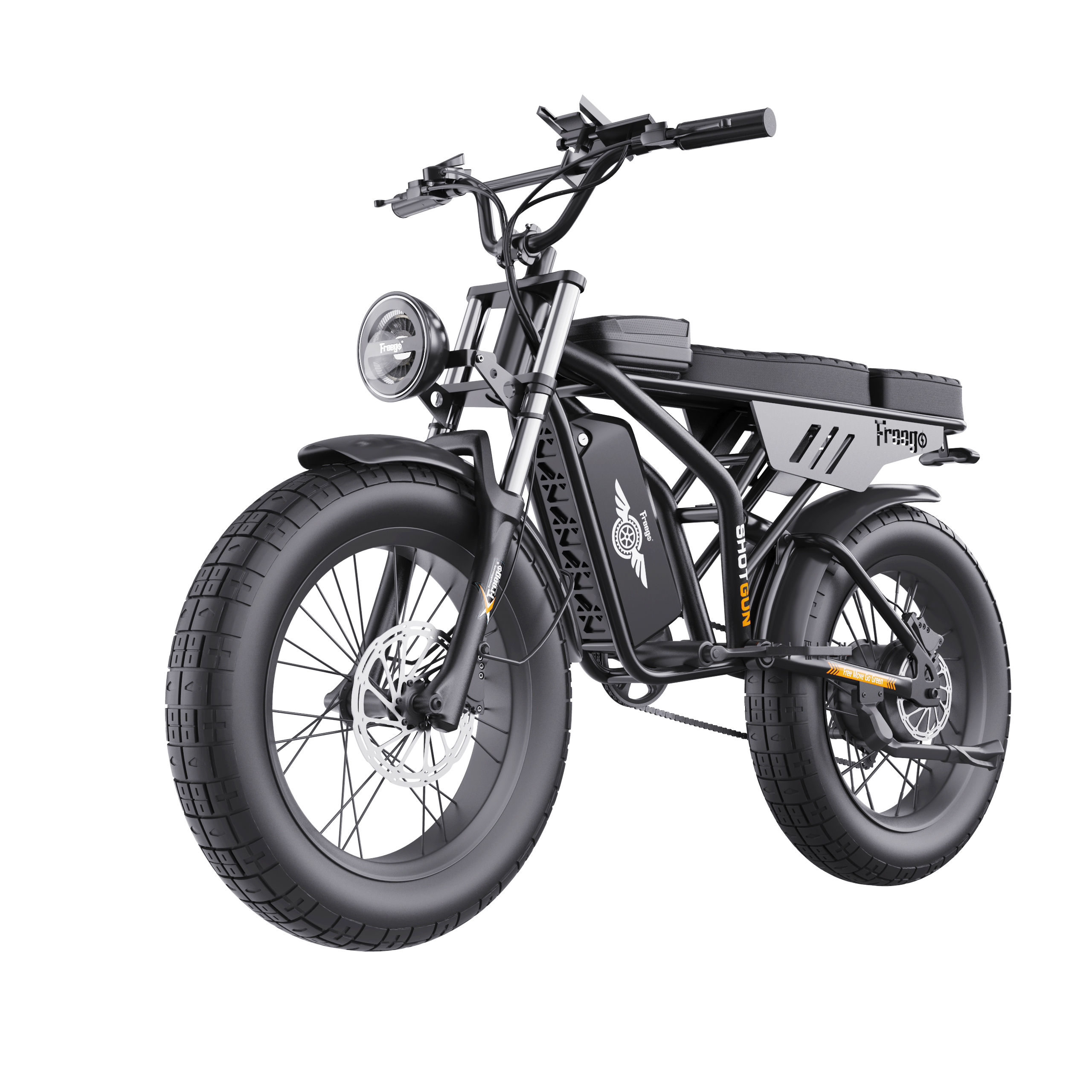
Why Fat Tire E-Bikes Excel on Soft, Low-Traction Terrains
Flotation Physics: How 3.8—5.0" Tires Distribute Weight to Prevent Sinking in Snow, Sand, and Mud
Wider tires ranging from 3.8 to 5 inches give riders a bigger footprint on the ground, spreading out the combined weight of both rider and bicycle when riding over soft terrain. When run at lower pressures around 5 to maybe even 15 psi, these wide rubber treads actually squish and mold themselves around whatever surface they're rolling on rather than just digging straight down. What this does is create what some call the flotation effect, which cuts down how much pressure gets applied to the ground beneath by roughly two thirds compared with regular narrower tires. The result? Less sinking into tricky conditions such as powdery snow drifts or shifting desert sands where normal tires would just disappear.
Traction Dynamics: Motor-Assisted Torque Delivery Meets Low-PSI Tire Deformation
The way electric motors work gives riders better traction because they deliver power instantly and can be controlled precisely. Pair these motors with those big low-pressure tires that actually mold around obstacles like tree roots, rocks, and all sorts of rough terrain, and what do we get? A really good grip system that responds well to different conditions. Those tires squish down when they hit loose gravel, making about twice as much contact with the ground compared to regular setups. Meanwhile, the motor keeps things moving forward even when traditional bikes would just stop dead in their tracks. Riders can tackle muddy hills or sandy patches without worrying about wheelspinning or losing grip completely, something that happens all too often with narrower tire options.
Performance Validation Across Key Off-Road Environments
Snow & Ice: Real-World Winter Commuting Data from Minnesota and Alaska (2023—2024 User Surveys)
Recent surveys from riders in Minnesota and Alaska during last winter tell us a lot about how fat e-bikes handle icy conditions. Around 78 percent of people who commute regularly said they could still get around on paths covered in ice when their bikes had those special studded tires. About two thirds managed to keep going at their usual pace even when temperatures dropped below minus fifteen degrees Celsius. The motor assistance makes a big difference too. Riders found their wheels slipped about forty percent less than on regular bikes without power help. Lower tire pressure also helps grip the ice better. When inflated under five pounds per square inch, tires actually make twice as much contact with the frozen surface. All this shows why these bikes work so well in winter. With proper setup, electric fat bikes really break down the usual problems people face getting around during cold months.
Sand & Mud: Comparative Grip Metrics Using ASTM F1711 Standards and Field Testing
Standardized ASTM F1711 testing shows fat tires generate 2.3× greater forward traction in saturated mud than standard mountain bike tires. Field measurements of lateral grip on coastal dunes further illustrate their advantage:
| Surface | Standard Tire Slip Angle | Fat Tire Slip Angle | Improvement |
|---|---|---|---|
| Wet Clay | 18° | 7° | 61% |
| Dry Sand | 25° | 11° | 56% |
The combination of 4.8-inch tire deformation and torque-sensing pedal assistance enables predictable power delivery where conventional bikes lose momentum—because fat tires compress terrain surfaces rather than shear through them.
Balancing All-Terrain Capability with Urban Practicality
Mixed-Terrain Efficiency: Trail-to-Pavement Transitions and Range Impacts of Fat Tire Rolling Resistance
Fat e-bikes deliver unmatched versatility, but their wide tires introduce measurable trade-offs on hard surfaces. While 3.8—5.0" tires provide exceptional flotation off-road, their high surface area increases rolling resistance by 15—30% on pavement versus standard mountain bike tires. This directly affects battery efficiency:
- Range reduction: Expect 10—15% lower mileage on paved routes versus dirt trails
- Speed trade-offs: Maintaining 15 mph on pavement requires ~20% more motor assistance than on packed snow
- Terrain adaptation: Adjusting tire pressure (8—12 PSI off-road vs. 15—20 PSI on-road) helps mitigate drag without sacrificing stability
For riders regularly transitioning between trail and pavement, mid-drive motors offer superior torque management, and hybrid-compound tires balance off-road grip with reduced urban rolling resistance.
Year-Round Fat Bike Usability: Weather Resilience and Operational Limits
Fat e-bikes are engineered for four-season reliability. Ultra-low tire pressure (typically 5—8 PSI) delivers unmatched surface flotation across snow, sand, and mud—enabling stable travel where conventional bikes fail. Cold-optimized lithium batteries maintain consistent power delivery down to —20°C (—4°F), and hydraulic disc brakes ensure precise stopping on icy terrain.
There are definitely some boundaries to consider when riding these bikes. If the powder gets too deep and starts forming ruts over an inch deep, the ground simply won't support the weight properly anymore. Cold weather is another issue too. When temps stay below freezing for long periods, most batteries lose around 15 to 30 percent of their usual range. The special puncture proof tires do handle rough trails and city garbage pretty well thanks to those reinforced sides. Still, nobody wants to ride through sharp volcanic rock that's harder than what the tire was designed for. These bikes can take quite a beating though, so they work surprisingly well throughout the seasons in places where roads aren't maintained much during winter months.
FAQs
What are the advantages of using fat tire e-bikes on soft terrains?
Fat tire e-bikes are excellent on soft terrains due to their wide tires which distribute weight more efficiently, reducing the chance of sinking and providing better traction across challenging surfaces like snow, sand, and mud.
How do fat tire e-bikes perform in winter conditions?
In winter, fat tire e-bikes perform well due to features like studded tires and low tire pressure which enhance traction on ice. Surveys show a significant reduction in slippage compared to regular bikes.
Do fat tire e-bikes have any drawbacks on urban terrains?
Yes, while they excel off-road, fat tire e-bikes face increased rolling resistance on pavement, leading to a 10–15% reduction in range. Adjusting tire pressure can help balance performance across different terrains.